Last updated August 2026
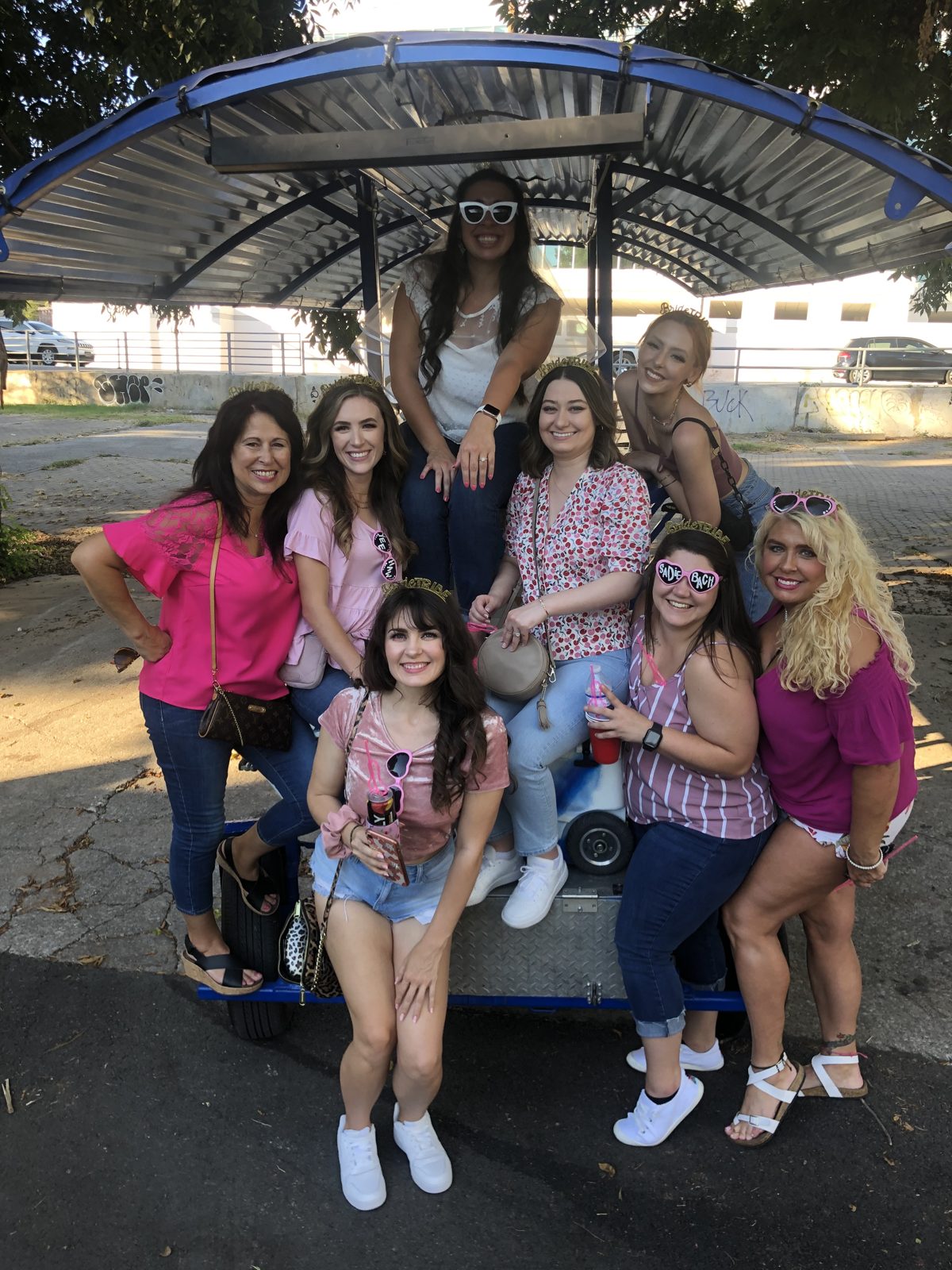
It's the single most-asked question I get, and people usually ask it sideways — a text that starts "this is going to sound dumb, but..." It isn't dumb. It's the most practical question you can ask before you put money down, because the answer changes the entire day for somebody in your group. So: on most Austin pedal pubs, yes, you pedal. On ours, nobody pedals, ever. Here's everything underneath that sentence.
I've owned and driven an Austin party bike since 2018 — 1,098 rides and counting. I've watched thousands of people get on a bike expecting one thing and find another, and I've had a lot of conversations at the meet point that start with "wait, we have to what?" This page exists so nobody has that conversation again. I'll quote the other Austin operators directly, in their own words from their own 2026 websites, and I'll make the honest case for pedaling too, because there is one.
"Pedal pub," "pedal tavern," beer bike and "party bike" are used interchangeably in Austin, and they describe two very different machines. The pedal-powered ones need roughly six to ten people actively pedaling to move — a motor helps, but it does not replace you. Fully electric ones like ours have no pedals for passengers at all. If you don't want to find out which one you booked at 7pm on a Saturday in August, ask one question before you pay: "How many people have to pedal?"
The short version
- Austin Bar Bike: fully electric. Zero pedaling. A sober professional driver handles everything; you sit at the bar rail and drink.
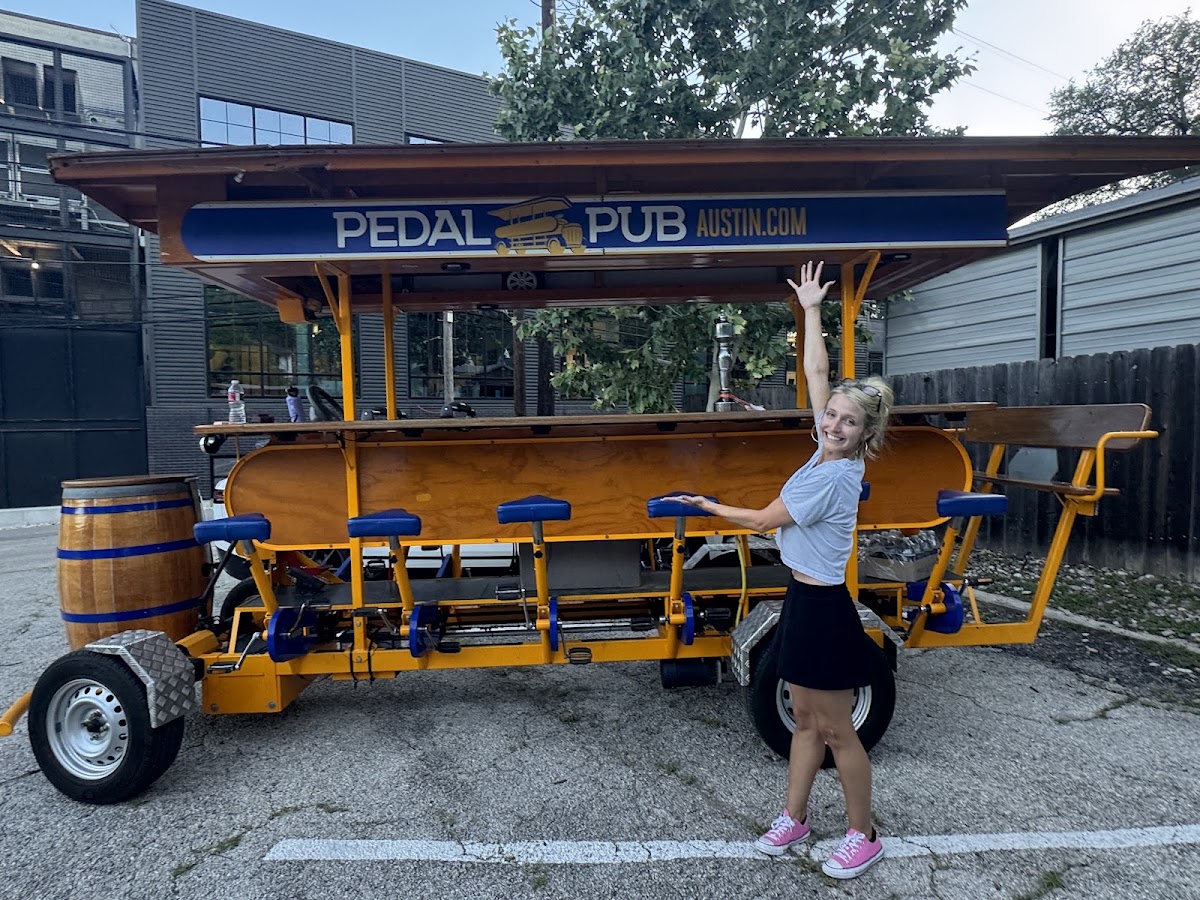
- Pedal Pub Austin: their own FAQ answers "do you have to pedal" with "Yes and No" — you pedal, and an electric assist kicks in while you're pedaling. Ten pedaling seats, four non-pedaling.
- Trolley Pub Austin: you pedal, with a motor assist onboard. Minimum six pedalers.
- Austin Pedal Party: you pedal — "a minimum of 6 pedalers to move the bike efficiently" — with assisted driving offered as an option.
- Hipside Peddler: drivers steer, "the power of your legs and feet" moves it, with motorized assist.
- The heat is the real variable. Austin's normal August high is 97.8°F, and the city averages 29 days a year at or above 100°F. Pedaling is a different proposition here than it is in Denver.
Why the words are the problem
There is no industry standard here, and that's the whole mess in one sentence. The Dutch built the original machines in the late 1990s as fietscafés — literally "bike cafés" — and when the concept crossed the Atlantic, every city and every operator named it something different. Minneapolis got "Pedal Pub." Nashville got "pedal tavern." Austin, being Austin, uses all of them plus "party bike," "beer bike," "bar bike" and "the bachelorette thing."
None of those names tells you anything about the drivetrain. "Pedal pub" is a brand name that became a generic term, the way people say Kleenex. "Party bike" is a category, not a mechanism. A tour operator can legally and honestly call a fully pedal-powered bike a "party bike," and can equally honestly call an electric one a "pedal pub" because that's what customers type into Google. Both are doing normal marketing. Neither is answering your question.
So the only reliable way through is to stop asking what is it called and start asking how does it move. There are exactly three answers in Austin right now: you pedal, you pedal with a motor helping you, or a motor does all of it. That's the entire taxonomy.
What Austin's operators actually say in 2026
I went through every Austin operator's live site and pulled their own language rather than characterizing them secondhand. I own a competing business, so I'm going to be scrupulous about this: these are quotes, they're accurate as of August 2026, and every one of these companies runs a legitimate operation that a lot of people love. Prices and policies change, so confirm anything that matters to you.
Pedal Pub Austin is the most transparent of the group, and I'll give them full credit for it. Their FAQ takes the question head-on and answers: "Yes and No. The Pedal Pubs are equipped with electric pedal assists that kick in when you are pedaling." They go further and break down the seating — "there are 5 pedaling seats on each side," plus four seats that don't require pedaling: one over each rear wheel and a rear bench for two. Minimum six people to operate. A driver is always onboard. Their Austin page lists 2-hour tours with 2–3 stops, seats from $29 and private bikes from $350, with each bike seating up to 14.
Trolley Pub Austin frames it reassuringly: "It's not too bad! We have had groups of all 70+ seniors pedal just fine. If they can do it, you can do it!!! And we have a motor assist onboard." Their trolleys hold up to 15, tours run 2 hours, private bikes are listed at $449 and public mixer seats at $44 with a six-passenger minimum, and there's "a certified Trolley Pub Driver/Party Host on board." They depart from 409 Tillery St on the east side.
Austin Pedal Party is the most explicit about the labor math: "We need a minimum of 6 pedalers to move the bike efficiently. We can take a maximum of 15 people." They soften it with "pedaling passengers are only asked to exert a level of energy that is comfortable for that individual," and they offer "high-quality assisted driving as an optional bolster for your tour." Note the word optional — if a motor doing the work matters to you, that's a thing to confirm on your specific booking, not assume. They run from 806 San Jacinto Blvd, 11am to 11pm daily, at $35 a seat or $350 for a private bike.
Hipside Peddler splits the job cleanly in their own copy: "our trained drivers steer you through the streets" while the vehicle moves on "the power of your legs and feet," with motorized assist available. Public tours run 6–15 people from $45 a ticket; private rides start at $495 and can be arranged for larger groups.
Read those four descriptions again and notice what they have in common: every single one mentions a motor, and every single one still expects your legs. That is not deception. That is precisely what pedal-assist means, and it's the thing most people misread.
| Operator | Do riders pedal? | In their own words | Non-pedaling seats |
|---|---|---|---|
| Austin Bar Bike | No — never | Fully electric; a sober professional drives | All 15 |
| Pedal Pub Austin | Yes, with e-assist | "Yes and No... electric pedal assists that kick in when you are pedaling" | 4 of 14 |
| Trolley Pub Austin | Yes, with motor assist | "It's not too bad!... And we have a motor assist onboard" | Not specified |
| Austin Pedal Party | Yes; assist optional | "A minimum of 6 pedalers to move the bike efficiently" | Not specified |
| Hipside Peddler | Yes, with motorized assist | Moves on "the power of your legs and feet" | Not specified |
Quotes pulled from each operator's own website, August 2026. Seat counts and policies change — confirm directly. For prices, refund policies and a full operator-by-operator breakdown, see our Austin party bike comparison.
What "electric assist" actually means
Here's the part that trips everyone up, and it isn't anyone's fault — it's a genuinely confusing piece of engineering language.
"Pedal assist" is a specific technical term borrowed from e-bikes. It means the motor only produces power while you are pedaling. Stop pedaling and the assist stops with you. It's not a throttle. It's not cruise control. It's a multiplier on effort you're already making, and if the effort is zero, the multiplier does nothing. Pedal Pub says this plainly — the assist "kicks in when you are pedaling" — and that phrasing is doing a lot of honest work that most readers skim right past.
Pedal-assist multiplies your effort. Fully electric replaces it. A bike can be truthfully advertised as "electric" and still require every able-bodied person on it to keep their legs moving. When you're reading an operator's site, the tell is the verb: if the sentence describes what the motor does when you pedal, you're pedaling.
There's a second wrinkle that only shows up in practice. Assist systems on these big machines are tuned for a group pedaling together at a modest cadence. They're generous, and they genuinely flatten the hard parts. But they're calibrated on the assumption that most of the pedal stations are occupied and working. When six of your ten pedalers stop — and they will stop, to take a photo, to open a drink, to answer a text, to have an argument about which bar is next — the assist doesn't scale up to cover them. The remaining four just feel it. That's the moment somebody in every group says "guys, come on," which is the exact sentence a bachelorette party did not fly to Austin to hear.
Ours is fully electric — here's what that changes
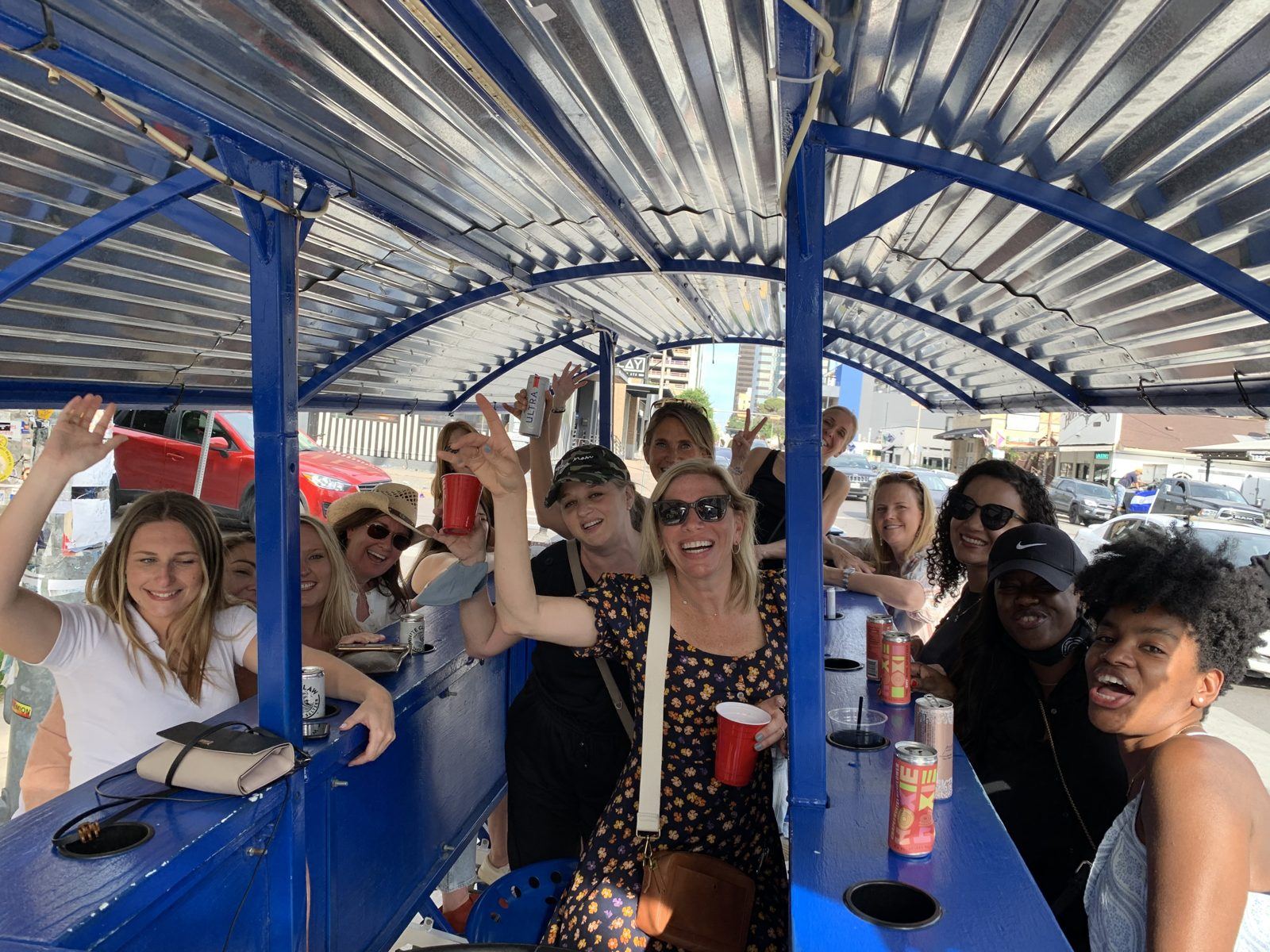
The Austin Bar Bike has no passenger pedals. Not disabled ones, not optional ones. There is a motor, there is a stone-sober professional driver in the operator's seat — usually me, since I own the thing — and there are 15 seats along a bar rail where you sit, face your friends, and drink whatever you brought.
What that actually changes is smaller and more specific than you'd think, and I'd rather describe it accurately than oversell it.
It changes who can come. Nobody sits out. Nobody gets assigned the "easy seat" and then feels weird about it for two hours. Your friend eight months into a pregnancy who's riding dry, your uncle with the replaced knee, your maid of honor in four-inch heels — they're all just riders, in the same seat as everyone else, with the same view.
It changes what your hands are doing. On a pedal bike your legs are busy and your center of gravity is over a moving crank; drinking is possible but fiddly, and the standard move is to wait for a stop. On ours, both hands are free the entire time. Cans get opened, photos get taken, somebody starts a chant, and none of it costs you forward motion.
And it changes the arithmetic of small groups. Every pedal operator in town needs roughly six pedalers minimum. If you're a party of six and two of them can't or won't pedal, you have a problem before you leave the lot. We don't have a minimum-effort threshold because there's no effort to threshold. Four people can book the whole bike and it moves exactly the same as fifteen.
Fully electric · ~2h15 · 2–3 downtown bar stops · from $275 Mon–Thu / $375 Fri–Sun for the whole bike, or seats from $29. Easy metered street parking at our 1108 Rose St meet point.
The physics: 15 adults and a steel frame
Let's do the arithmetic that nobody does before booking, because it explains why a machine that looks like a novelty is genuinely hard to move.
Call it 180 pounds a head — a reasonable average once you mix a bachelor party and a book club — and fifteen riders is roughly 2,700 pounds of passengers. That's more than a Mazda Miata, sitting on top of a frame that also has to carry a steel chassis, fourteen or fifteen seats, a canopy, a bar top, a sound system, coolers of ice and drinks, and in some cases a keg. The vehicle empties out somewhere in the neighborhood of a small car all by itself. Nobody publishes a spec sheet, so I won't pretend to a number, but the practical result is not in dispute: you're asking a group of casually-dressed people to accelerate something in the range of two tons from a dead stop, repeatedly, at every traffic light in downtown Austin.
That's the crucial detail — not the cruising, the starting. Once these things are rolling at eight miles an hour on flat pavement, they're not bad; momentum is doing most of the work and the assist covers the rest. It's the stop-and-go that costs you. A downtown route means signals, four-way stops, pedestrians stepping out of a bar, a rideshare stopping in the lane. Every one of those is another dead-stop launch, and a dead-stop launch of two tons is the single hardest thing your legs will do all night. Ten people who felt fine at minute five feel it at minute forty because they've done it thirty times.
Gearing helps — these bikes are geared very low, which is why nobody is straining like a cyclist on a climb. But low gearing trades force for distance: you spin your legs a lot to travel a little. It's not intense. It is constant. Two hours of constant is a real thing, and it's a completely different kind of tired than people are picturing when they imagine "a little pedaling."
Pedaling in an Austin summer
Here's where Austin stops being a generic pedal-pub city and becomes its own case study.
The National Weather Service normals for Austin put the average daily high at 93.2°F in June, 96.6°F in July, 97.8°F in August and 91.4°F in September. The city averages 123 days a year at or above 90°F and 29 days at or above 100°F. The all-time record is 112°F, hit twice — September 5, 2000 and August 28, 2011. That's not a heat wave. That's a normal year.
Temperature alone undersells it, because Central Texas carries humidity that the desert Southwest doesn't. The NWS's own worked example is instructive: at 96°F with 65% relative humidity, the heat index — what it actually feels like to a human body — is 121°F. Humidity that high isn't a typical Austin afternoon, but early evenings after a storm or a humid Gulf pattern get there, and even ordinary summer evenings push the apparent temperature well above the thermometer. Your body cools itself by evaporating sweat, and humid air slows evaporation down. So you sweat more and cool less. That's the mechanism, and it's why moderate exertion in Austin in August feels disproportionate to the effort you're putting in.
The prime booking window — 6pm to 9pm on a summer Saturday — is not the cool part of the day. It's the part of the day where pavement and buildings hand back the heat they absorbed since noon.
People assume an evening ride solves this. It helps. It does not solve it. Downtown Austin is a heat island of concrete, asphalt and glass, and it releases stored heat for hours after sunset. It's routinely still in the high nineties at 7pm in July. I drive through it four nights a week; I know exactly what that block of Trinity feels like at 7:15.
The practical consequence isn't heat illness — every operator in town carries water, watches their guests, and knows to pull over. The practical consequence is mood. People get quiet. Hair goes flat. The bride's makeup runs, and she notices, and it changes the photos, and it changes the night. That's the honest cost, and it's the reason I built an electric bike instead of a pedal one when I started in 2018.
The hills nobody warns you about
Austin does not read as a hilly city from a car, which is exactly why this catches people. Downtown sits above Lady Bird Lake, and the grid climbs as you move north away from the water. It's gentle. It's also two tons.
The stretch people feel is the pull up from the river toward the core — anything that starts near the Rainey Street district or Cesar Chavez and works north toward 6th Street. On a bicycle you'd barely register it. On a loaded party bike it's the section where the assist is working hardest and where a group that's been half-pedaling suddenly discovers it. Heading west toward West 6th has its own gentle rises too.
This is genuinely where pedal-assist earns its keep — the motors are tuned for exactly this and they do smooth it out. But "smoothed out" still means everybody needs to be pedaling at that moment, which is usually the moment the drinks are open and attention has wandered. It's also where the driver of a pedal bike will say some version of "alright, everybody pedal" in a voice that is friendly but is not really a suggestion. Some groups find that hilarious. Some groups find it the exact opposite of a vacation. Know which group you are.
Who actually struggles — and why it's never who you expect
After eight years of this I can tell you the person who has a hard time is almost never the person the group worried about. Everyone plans around grandma. Grandma is fine. She sits, she watches, she has the best time of anyone. The trouble comes from four other directions.
Footwear. This is the big one and nobody sees it coming. A pedal station is not designed for heels, wedges, platform boots or the strappy sandals half the bachelorette party bought for this exact night. The pedal is a flat platform, the crank is close to the seat, and a heel either slips off or wedges. The workaround is going barefoot on a metal pedal, which people do, and then regret. Groups that pedal should bring sneakers and swap; groups that don't want to swap should book electric. That's the whole calculus.
Mixed fitness in one group. A pedal bike doesn't distribute effort evenly — it distributes it to whoever's willing. In practice, two or three conscientious people over-pedal the entire route while the rest coast, and by the end those two or three are irritated and everybody can feel it. Nobody says anything, but the energy of the group shifts. Corporate outings are especially prone to this, because there's a status dimension to who's visibly working, and that is the exact opposite of what a team event is supposed to produce.
Guests who aren't drinking. Pregnant guests, designated drivers, people in recovery, people on medication, people who just don't drink. They're already the person doing the sober version of a drinking activity, and that's fine — plenty of people ride dry and have a great night. But asking them to also do the physical labor while everyone else is loose and having fun is a lot. On an electric bike a non-drinking guest is doing precisely what everyone else is doing, minus the beer. That's a meaningfully better experience for them and I've been thanked for it more times than I can count.
Old injuries. Knees, hips, lower backs, ankles. A repetitive low-resistance motion for two hours is exactly the kind of thing that feels fine at minute ten and is a problem at minute ninety, and by then you're a mile from where you parked. If anyone in your group has hardware in a joint or a bad flare-up pattern, ask the operator how many non-pedaling seats they actually have. Pedal Pub publishes four out of fourteen, which is honest and useful. If three of your people need one, you've used up the supply.
Don't ask "is it electric?" — almost everyone can say yes to that truthfully. Ask: "How many people have to be pedaling for the bike to move, and how many seats don't require pedaling?" That question has only one honest answer and it tells you everything.
In fairness: when pedaling is the fun part
I'd be a bad guide if I only made the case for my own bike, so here's the genuine other side, and I mean it.
Pedaling creates a shared task, and shared tasks bond people faster than shared drinks do. There's a real thing that happens on a pedal tavern where the group syncs up, somebody starts counting cadence, and for thirty seconds fifteen people are one machine. That's a memory. You don't get it by sitting. Groups that already like each other and are already physically inclined — a running club, a group of guys in their late twenties, a team that does hard things together on purpose — frequently prefer it, and they're not wrong to.
It also cuts against the "we just sat there" feeling that a small number of people report on any passive activity. And it's an unbeatable story: "we powered a bar down a street in Texas" beats "we rode a bar down a street in Texas," at least in the retelling.
So my honest recommendation, as the guy who profits from the other answer: if your group is under 40, physically willing, wearing flat shoes, riding between October and April, and you like the idea of doing something together — book a pedal bike. Pedal Pub and Trolley Pub both run good operations and you'll have a great time. I'd rather send you to the right ride than sell you the wrong one.
If any of those five conditions don't hold — and in an Austin summer, one of them always doesn't — electric is the answer.
What to ask before you book anyone
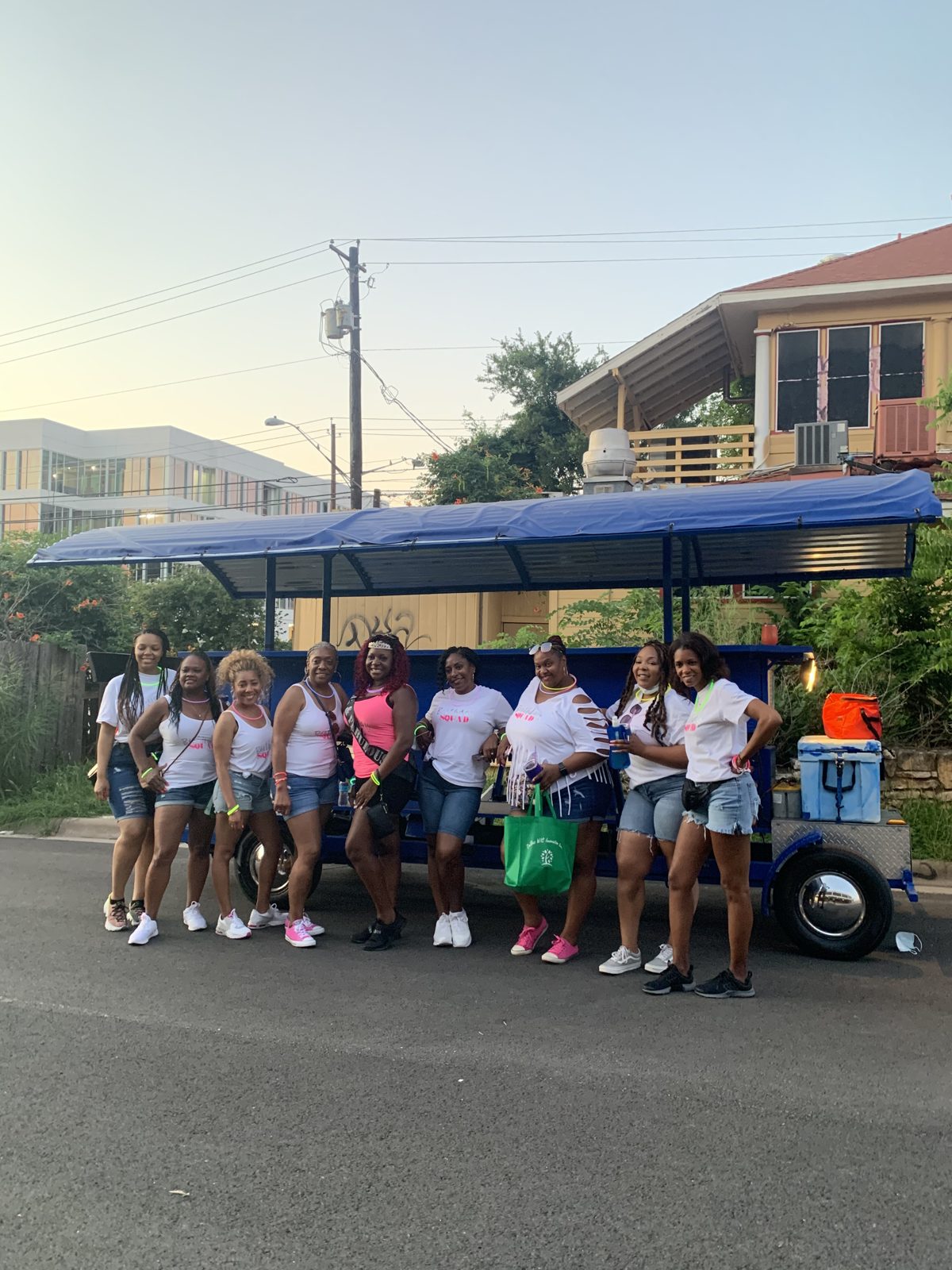
Whichever direction you go, these five questions take ninety seconds on the phone and prevent every bad version of this day:
- "How many people have to pedal for the bike to move?" The number is the answer. Six is common.
- "How many seats don't require pedaling, and can I reserve them?" Availability and reservability are two different things.
- "Is the assist included on my booking, or is it an add-on?" At least one Austin operator lists assisted driving as optional. Optional means confirm it.
- "What's your shade and water situation in July?" Canopies vary. Water policies vary.
- "Where do we park, and is it free?" A downtown departure point means downtown parking rates for every car in your group. Ours is easy metered street parking at 1108 Rose St — always spots, a couple bucks, which quietly saves a 15-person group real money — there's more on that math in our Austin party bike cost breakdown.
Mistakes people make
- Assuming "electric" means "no pedaling." The most common and most expensive misunderstanding in this entire category.
- Booking heels-first. If you're on a pedal bike, sneakers in a tote bag, swap at the meet point, change back for the bars.
- Booking a July afternoon slot. Even electric, 2pm in July is a lot. Evening is better for everyone. Our before your ride page covers what to bring.
- Not telling the operator about a guest's limitation. Every operator in town will work with you if they know in advance. None of them can fix it in the parking lot.
- Booking six people on a bike with a six-pedaler minimum. You have zero margin. One person taps out and the bike is short.
- Assuming Austin works like Nashville. Different heat, different regulations, different street layout — we broke that down in our Austin vs. Nashville bachelorette guide.
So, do you have to pedal?
On four of the five party bikes operating in Austin right now, yes — six or more of you, with a motor helping but not replacing you, for about two hours, in whatever weather Texas is having that day. Those are good rides and I'd send my own friends on them in November.
On ours, no. Never. It's fully electric, a sober professional drives it, and all fifteen seats are for sitting. That's the entire product decision, and eight years, 1,098 rides and a 4.9-star average across 203 Google reviews later, I'd make it again tomorrow.
If that's the ride you want, grab the whole bike for your group, or a single seat if you're a smaller crew. You can see exactly where we go on the route page.
15 seats · fully electric · BYOB cans & plastic (no glass or liquor) · ~2h15 with 2–3 bar stops · riders 18+, drinking 21+ · easy metered street parking at 1108 Rose St.