Last updated August 2026
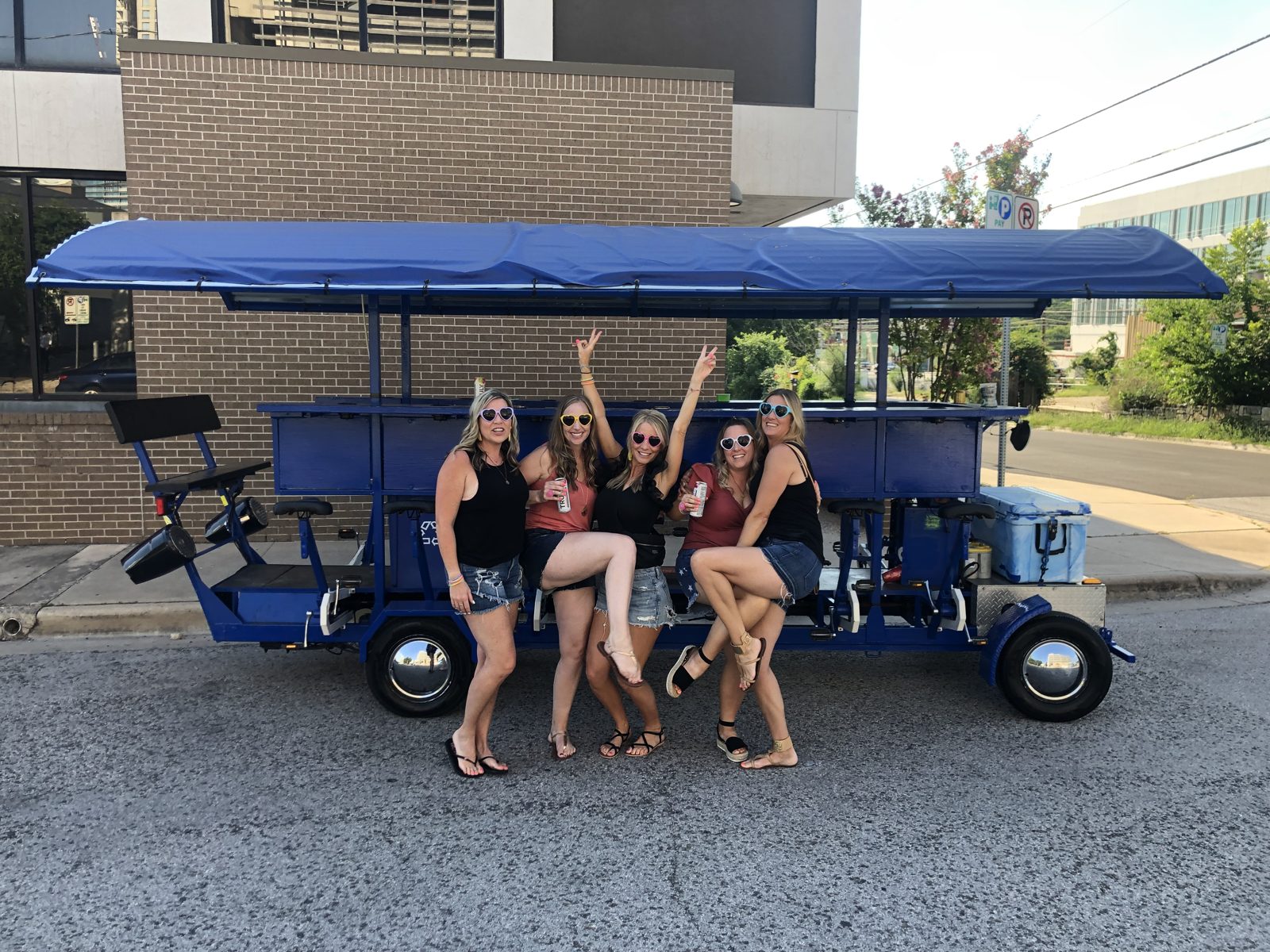
A beer bike is a fifteen-seat vehicle shaped like a bar. You sit at a rail facing your friends, somebody sober steers, you bring your own drinks, and it rolls slowly through downtown Austin stopping at bars. That's it. That's the whole product. The reason it takes 3,000 words to explain is that nobody agrees on what to call it, half of them make you pedal and half don't, and the price you see advertised is almost never the price a group of twelve actually pays.
My name's Matt. I've owned and driven an Austin beer bike since 2018 — 1,098 rides, 12,255-plus riders, one blue bike. This page is the overview I wish existed when people are three tabs deep at 11pm trying to figure out what they're even shopping for. It doesn't sell you anything until the end, and where another guide on this site goes deeper on a subject, I'll send you there instead of repeating myself.
Beer bike, bike bar, party bike, pedal pub, pedal tavern, brew bike, bierfiets and fietscafé all describe the same category of vehicle. None of the names is official. The only question that separates them into meaningfully different products is whether passengers have to pedal — and in Austin, four of the five operators say yes. In 2026 an Austin beer bike runs roughly $29–$45 per seat, or $275–$495 to book the whole thing, for about two hours and two to three bar stops.
Every name for the same machine
Search "beer bike Austin" and you'll land on pages calling themselves party bikes. Search "party bike" and you'll get pedal pubs. Search "pedal pub" and half the results are companies that aren't Pedal Pub. This is not a conspiracy. It's just what happens when a product arrives in a country without a name attached to it.
Here's how the vocabulary actually shook out. Pedal Pub is a Minneapolis brand name that got used so widely it went generic, the Kleenex of this category — which is why an operator with no connection to that company will still cheerfully use the phrase, because that's what people type. Pedal tavern is the Nashville term and it barely gets used in Texas. Party bike is the closest thing to a neutral category label, which is why it's the phrase most operators default to in their marketing. Beer bike and bike bar are what actual Austinites say out loud, usually as "that beer bike thing" or "the bike with the bar on it." Brew bike shows up occasionally. And bierfiets or fietscafé are the Dutch originals, which almost nobody in Austin says but which explain everything about how this thing exists.
I named my company Austin Bar Bike in 2018 for exactly this reason. "Bar bike" is what my first customers called it before I could tell them what it was called. Eight years later I still get voicemails that start "hi, is this the beer bike people?" Yes. It is.
Where beer bikes actually came from
The machine is Dutch and it is older than most people assume. Het Fietscafé BV in the Netherlands built the first one in 1997 — literally a "bike café," a rolling table with pedals underneath, built for a country where cycling is transport rather than recreation and where a bar on wheels reads as a perfectly sensible idea rather than a stunt.
It took roughly a decade to cross the Atlantic, and when it did it hit the exact American cities you'd expect: Minneapolis, Nashville, Denver, Austin. Every one of those markets named it something different, and every one of them ran into the same regulatory question at roughly the same time, because a vehicle that carries fifteen drinking adults down a public street is not a thing any city's code was written to anticipate.
The cautionary tale is Amsterdam, where the original city ended up banning beer bikes from its center at the end of 2017 — too much noise, too much congestion, too many of them in too small a space. That's a useful thing to know if you're wondering why every Austin operator is fussy about rules, why nobody lets you bring glass, and why the good ones stay off certain blocks at certain hours. The industry has already watched a city decide it was over the whole thing. Nobody here is eager to run that experiment again.
The name-to-meaning decoder
If you're comparing options across tabs, this is the translation table. The important column is the last one, because the name genuinely does not tell you how the thing moves.
| Name | Where it comes from | What it actually means | Tells you if you pedal? |
|---|---|---|---|
| Beer bike | Plain English / Texas usage | Any pedal-or-electric group vehicle with a bar top | No |
| Bike bar / bar bike | Austin colloquial | Same vehicle, described by the bar rather than the beer | No |
| Party bike | Industry-neutral category term | The closest thing to an official label | No |
| Pedal pub | Minneapolis brand, now generic | Often a brand; often just a search term | No — despite the word |
| Pedal tavern | Nashville | Same vehicle, rarely used in Austin | No |
| Fietscafé / bierfiets | Dutch, 1997 original | "Bike café" — the ancestor of all of them | Historically yes |
The only reliable question is "how many people have to pedal for this to move?" — we break down every Austin operator's answer, in their own published words, in the do-you-have-to-pedal guide.
Two machines wearing one name
Under all that vocabulary there are exactly two products, and the difference is not cosmetic.
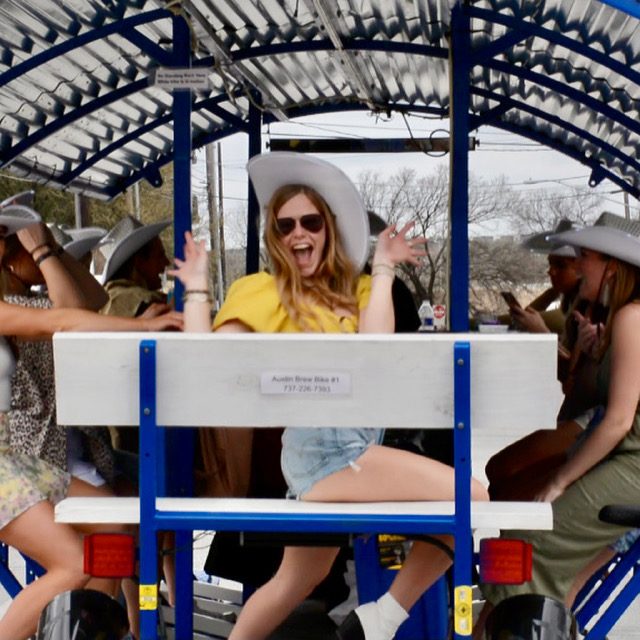
The pedal-powered version has ten or so pedal stations along the sides and needs roughly six people actively working for the bike to move, with an electric assist that multiplies effort rather than replacing it. Four of the five Austin operators run this. It's the original design and there is a genuine argument for it — shared effort bonds a group in a way shared drinking doesn't.
The fully electric version has no passenger pedals at all. A motor moves it, a sober professional drives it, and every seat is a sitting seat. That's what mine is, and it's the only one in Austin built that way.
I'm not going to re-argue that here because I've already written the long version, complete with direct quotes from every operator's own 2026 website and an honest case for pedaling: do you actually have to pedal a pedal pub? The one-line takeaway is that "electric" and "no pedaling" are not synonyms, and the word you're looking for on a booking page is not electric — it's assist.
An Austin beer bike ride, hour by hour
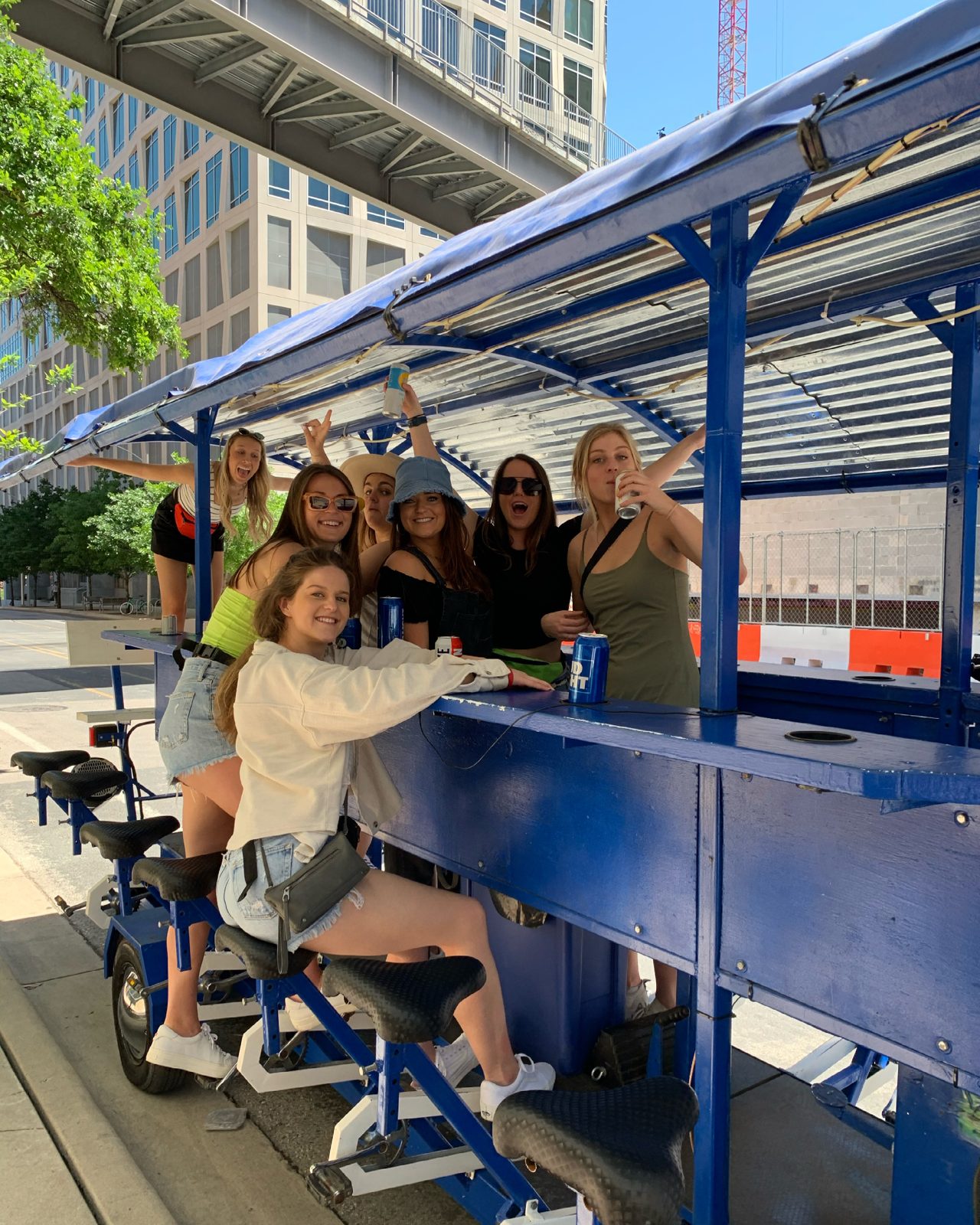
Nobody publishes this, and it's the thing people most want to know before they hand over a card. Here's how a real two-hour-fifteen ride runs on my bike. Other operators vary in the details but the shape is the same everywhere.
T-minus 30 minutes: the grocery run
The single most common rookie error is treating the departure time as the arrival time. Groups build in fifteen minutes and then somebody's still at the store. Buy your drinks the night before if you can. If you're doing it same-day, the H-E-B and Whole Foods on Lamar runs are both short hops from our meet point. What actually goes in the cooler is its own subject — see the BYOB packing guide.
15 minutes out: parking and the awkward mingle
We meet at 1108 Rose St, deliberately off the downtown grid, where there's easy metered street parking right there instead of a $25 garage and eleven minutes of circling. Feed the meter, don't skip it. Fifteen people arrive in four or five cars over about ten minutes, and there's always a stretch where six of you are standing on a sidewalk in Austin holding a cooler wondering if this is the right address. It is. The blue bike is not subtle.
Departure: loading, coolers, the safety spiel
Loading fifteen adults and their drinks takes about five minutes if everybody's there and about twenty if they aren't. Coolers go under the rail. I run through the short version of the rules — stay seated while we're moving, hands inside, cans only, and yes you can absolutely be loud — and then we roll. The first ninety seconds are always the same: everybody's quiet, taking it in, and then somebody cracks the first can and the volume comes up and stays up for two hours.
Minutes 0–25: the roll in
We come off Rose Street and drop down 2nd Street, which is the prettiest approach to downtown and the part nobody expects. Restaurant patios on both sides, people at dinner turning to look, and the skyline stacking up in front of you. This stretch is where the group photo happens, because the light is good and nobody's a drink deep enough to blink yet. Take it here. You'll thank me at midnight.
Minutes 25–50: first bar stop — 4th & Lavaca
The Warehouse District. This is the civilized stop: patios and rooftops rather than sticky floors. Lavaca Street Bar is the reliable pick for a group of fifteen that needs to actually fit somewhere, Halcyon if half your group wants coffee or a cocktail rather than another beer, and Twin's Rooftop if you want elevation and a view. Twenty to twenty-five minutes on the ground. The move here is to send one person ahead to the bar while everyone else is still climbing down — fifteen people arriving at a bar simultaneously is a twelve-minute wait you don't have to eat.
Minutes 50–80: second stop — 6th & Trinity
Now it gets loud. This is the heart of the 6th Street strip, and it's the stop that reads exactly like the postcard: live music leaking out of doorways, the street closed to cars on weekend nights, dueling pianos at Pete's, Maggie Mae's for a rooftop, The Blind Pig for a dive that hasn't been renovated into anything. The local knowledge: 6th Street before 9pm and 6th Street after 11pm are two entirely different neighborhoods. A beer bike ride puts you there in the good window, which is genuinely one of the underrated arguments for the whole format.
Minutes 80–115: third stop — West 6th
Cross under the interstate and West 6th is the grown-up version of the strip — beer gardens, rooftops, patios, a crowd that skews slightly older and considerably more Austin. Little Woodrow's, Star Bar, Rustic Tap, and Taquero Mucho if the group has hit the point where somebody needs queso immediately.
You don't have to ride back. Most groups don't. If your night is continuing on West 6th, hop off at the last stop, and the bike goes home without you — no shuttling back to a parking spot at the exact moment the party's peaking. Just leave one sober driver's car parked wherever's convenient for them, or plan on rideshares. Decide this before you book, because it changes where people park.
The last 15 minutes: the loop home, or not
If you are riding back, the return leg is quietly the best part. Everyone's warm, the coolers are lighter, the sun's gone, and the skyline lights up behind you on the way west. It's the part of the ride that shows up in people's reviews and never in anybody's marketing. The full route with every bar at every stop is mapped on our route page.
The legal frame, in one paragraph
Drinking on a beer bike in Texas is legal for a specific, narrow reason and it's worth understanding. Texas Penal Code §49.031 makes an open container in the passenger area of a vehicle on a public road a Class C misdemeanor — moving, stopped, or parked. The exception that beer bikes operate under is written into the same statute: it doesn't apply to passengers in a vehicle used primarily to transport people for compensation, the same bucket as buses, taxis and limos. So a chartered bike with a sober professional at the controls is fine. Your own car on the way home is not, which is why leftovers go in the trunk. Everything else — no glass, no liquor bottles, cans and plastic only, riders 18+ and drinking 21+ — is operator and insurance policy layered on top of that, and the reasoning behind each rule is broken down properly in the BYOB guide.
What it costs in 2026
Austin beer bike pricing sorts into two shapes: buy a seat on a public ride with strangers, or book the whole bike for your group.
Seats across town run roughly $29 to $45 a head. Whole-bike private rates run $275 to $495 depending on operator and day. Mine is $275 Monday–Thursday and $375 Friday–Sunday for up to fifteen people — which is about $18 a head with a full bike — or $29 a seat Mon–Thu and $35 Fri–Sun, currently the cheapest party bike seat in Austin on a weeknight.
The number that matters isn't the sticker, though. It's the sticker plus booking fees, plus parking for four or five cars, plus what you spend at the bars, divided by however many people actually show up. That arithmetic — including the fees other operators add at checkout and the six ways to pay less — is worked all the way through in the Austin party bike cost breakdown. If you only read one number off this page: a full private bike midweek works out cheaper per person than most people's bar tab that same night.
Renting one in Austin: the short list
Five operators are worth knowing about, and I'll be blunt about the fact that I'm one of them.
Pedal Pub Austin is the oldest operation in town, started in 2010 under a different name, and the right call if you need multiple bikes for a big corporate group. Austin Pedal Party is the other low-price option and runs a lot of public departures. Trolley Pub departs from the east side and can link two bikes for up to 30. Hipside Peddler is built around East Austin bars rather than downtown, costs more, and is the pick if 6th Street is the opposite of what you want. And Austin Bar Bike — me — is one blue electric bike, no pedaling, 2h15 instead of the standard two hours, full refund up to 24 hours out.
I've put every one of their published rates, capacities, refund windows and departure addresses side by side, sourced from their own sites, in the Austin party bike comparison, including a list of the situations where you should book a competitor instead of me. There are several.
Fully electric · 2 hr 15 min · 2–3 downtown bar stops · BYOB · $275 Mon–Thu / $375 Fri–Sun for the whole bike, or seats from $29. Easy metered street parking at 1108 Rose St. Full refund to 24 hours. Code SUMMER10 takes 10% off online.
Who a beer bike is actually for
After 12,255-plus riders I can tell you exactly which groups get the most out of this, and it's not who the ads suggest.
Bachelorette and bachelor parties are the obvious one and they're the majority of my calendar, but the reason it works isn't the drinking. It's that a beer bike solves the hardest logistical problem of a bachelorette weekend: getting twelve people who don't all know each other from one bar to the next without losing three of them. Everyone's on the same vehicle. Nobody gets left behind at a bar. The bachelorette page goes into the weekend planning.
Birthdays, especially the 30th and 40th kind where the guest list mixes college friends and coworkers and neighbors who've never met. Two hours facing each other on a bench with drinks does more introducing than any restaurant table ever has.
Corporate outings and team events. This one surprises people, but it's my fastest-growing category, and the reason is the seating geometry. Fifteen people at a rail all facing inward is the opposite of a conference room. Nobody sits at the head of the table because there isn't one. Details on the corporate page.
Out-of-towners who want to see downtown without a tour guide voice. You get 6th Street, West 6th, the Warehouse District and the skyline in two hours with your own soundtrack and no narration about the history of the state capitol.
Anyone who wants a bar crawl without the walking. That's the honest core of the appeal. Three bars on foot in an Austin August is a death march. Three bars on a moving bar is a good night.
Who should book something else
Equally honest list, because sending someone the wrong direction costs me more than the booking is worth.
If your group is over 30 people, you need a fleet operator or a party bus, not one bike. If you need a bathroom on board, this isn't it — you go at the bar stops, which is fine for two hours and a problem for anyone it isn't. If you have kids in the group, riders have to be 18+. If your group's idea of a good time is a quiet evening, a beer bike is a rolling loudspeaker and you will not enjoy it. And if you want the we-powered-it-ourselves story, book a pedal bike, genuinely — mine will feel too easy.
Booking it without screwing it up
Five things, learned from watching people get them wrong for eight years.
Book earlier than feels necessary. Spring and fall Saturdays in Austin go weeks ahead. If you're planning around a wedding date, lock the bike when you lock the hotel.
Read the refund window before the price. This is the single biggest hidden difference between operators in this city and almost nobody checks it. Some want fourteen days' notice. At least one lists all sales as final unless you buy an add-on. Mine is a full refund up to 24 hours out. Plans change; know what that costs you.
Ask how many people have to pedal. Worded exactly that way. "Is it electric" gets a yes from nearly everyone truthfully and tells you nothing.
Pick a weeknight if the date is flexible. Monday through Thursday is $100 cheaper on my bike, downtown is more pleasant, the bars aren't slammed, and you'll get a better ride out of it. Tuesday on 6th Street is an underrated Austin experience.
Tell the operator about the edge cases in advance. A guest who's pregnant, a bad knee, someone in a wheelchair, a surprise, a specific bar you want to hit. Every operator in town will work with you if they know beforehand. None of us can fix it in the parking lot at 6:58.
So: what is a beer bike?
It's a Dutch invention from 1997 that Austin adopted, renamed six different ways, and turned into the default answer for what to do with fifteen people and an evening. The names don't matter. The pedaling does, the refund policy does, and the per-person math does — and there's a guide on this site for each of those.
Mine is the fully electric Austin beer bike. One blue bike, fifteen seats, no pedals, BYOB, two hours fifteen minutes through downtown, usually with me driving. 4.9 stars across 203 Google reviews, 1,098 rides since 2018. Book the whole bike if you've got a group, grab a single seat if you don't, or just call and ask me anything.
15 seats · fully electric, no pedaling · BYOB cans & plastic (no glass or liquor) · ~2h15 with 2–3 bar stops · riders 18+, drinking 21+ · easy metered street parking at 1108 Rose St · full refund up to 24 hours.